

Fulfilment quotes are some of the hardest documents in eCommerce to compare. Two providers can quote the same business, both look reasonable, and yet the real monthly cost can differ by thousands of pounds once the orders start flowing. The reason is simple. There is no standard way to price third-party logistics, so every 3PL builds its rate card differently, packages fees in its own way, and uses its own terminology for the same activity.
We’re trying to break down 3PL pricing for the UK market. In this article, we’ll cover what each fee actually pays for, the typical pricing models you will encounter, current UK benchmark figures, the hidden costs that catch growing brands out, and a practical method for comparing two quotes on a like-for-like basis. The aim is to help operations leads and founders read a quote properly and budget with confidence, rather than discovering the true cost on the first invoice.
What You Are Really Paying a 3PL For
A 3PL fee is never one number. It is a bundle of separate charges, each tied to a different part of the fulfilment process. Once you can see the components individually, the quotes start to make sense, and the comparison becomes possible.
These are the core cost components in almost every UK 3PL agreement:
- Goods-in and receiving: unloading your stock, checking it against the delivery note, and logging each SKU into the warehouse system.
- Storage: the ongoing cost of holding your inventory, based on the space it occupies and how long it sits there.
- Pick and pack: the labour of locating each item, assembling the order, and preparing it for the courier. Usually the busiest line on your invoice.
- Packaging materials: boxes, mailers, void fill, tape, and labels. Sometimes included in the pick and pack rate, sometimes billed separately.
- Shipping and courier: the cost of moving the parcel to your customer, almost always charged separately from fulfilment.
- Returns: receiving, inspecting, and restocking or disposing of items that come back.
- Account management and technology: support, reporting, and the software integration that connects your store to the warehouse.
Different providers roll these up differently. One might fold packaging and account management into a single per-order rate, while another itemises every charge. That is exactly why a low headline figure can hide a higher total, and why the rest of this guide focuses on seeing the whole picture rather than any single line.UK 3PL Pricing Benchmarks
Most pricing guides quote US dollars and US shipping structures, which are not much use to a UK business budgeting in pounds. The table below pulls together current UK benchmark ranges so you have realistic figures to sense-check any quote against. Treat these as indicative starting points, since the actual rate depends on your volume, product type, and the warehouse location.
| Cost component | Typical UK range | How it is usually charged |
| Goods-in and receiving | £10 to £30 per pallet, or £25 to £50 per hour | Per pallet, per hour, or per unit |
| Storage | £10 to £30 per pallet per month, or per unit per day | Per pallet, per bin or shelf, per cubic metre, or per unit |
| Pick and pack | £0.45 to £2.60+ per order | Per order, per item, or a base fee plus per extra item |
| Packaging materials | £0.10 to £0.50 standard, up to £5 for branded or eco | Per package, varies with material |
| Returns | £0.50 to £2.00 per returned item | Per item, sometimes plus a restocking fee |
| Shipping | Billed at the provider’s negotiated carrier rate | By weight and parcel dimensions |
Sources for these ranges include UK provider rate cards and published cost breakdowns from e-pickpack, PackPro Fulfilment, Beckdale Shipping, and Fulfillable, alongside the CFO-focused cost model published by ProFulfilment, which puts simple UK order fulfilment at a benchmark of £1 to £3 per order.
A clear pattern runs through all of this data. Pick and pack costs fall as volume rises, because fixed overheads spread across more orders. One UK provider’s published rates drop from around 90p per order at starter volumes to roughly 60p at enterprise volumes, and small-item picking can fall as low as 45p at very high volume with minimal SKUs. The chart below shows that downward curve.
Indicative pick and pack cost per order as monthly volume grows
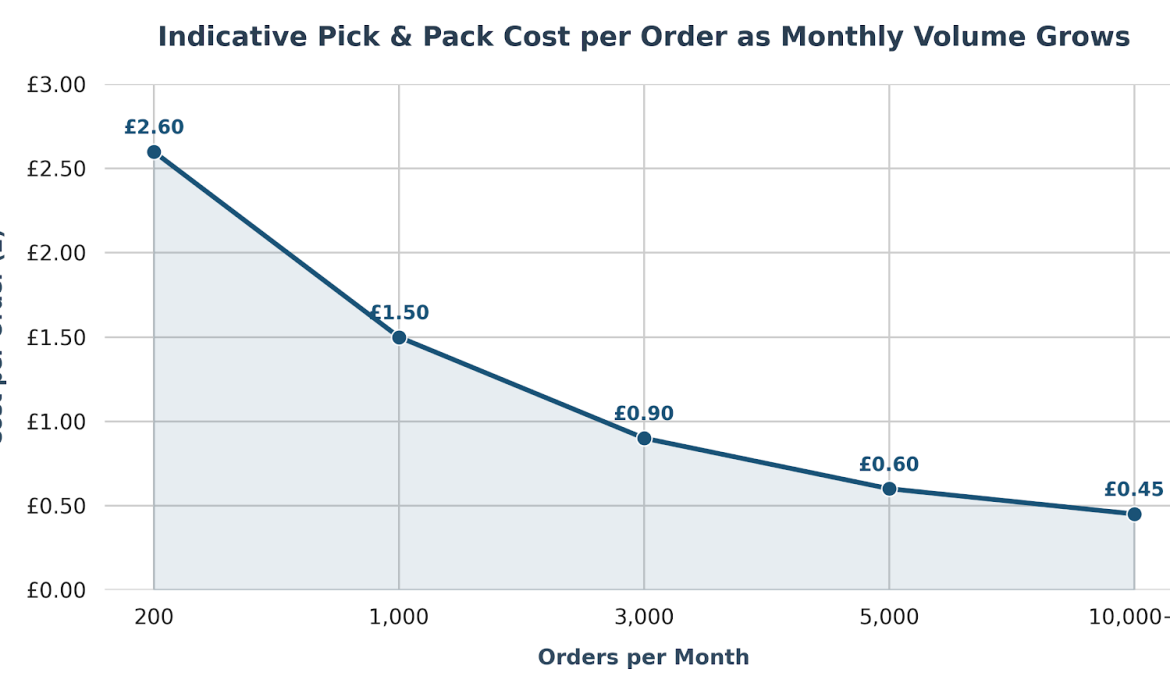
The takeaway for a scaling brand is that your cost per order should fall as you grow. If a quote keeps the same per-order rate at 5,000 orders that it charged you at 500, that is a question worth raising.
Why UK Shipping Costs Differ From US Guides
Shipping is usually the single largest line in any fulfilment budget, and it behaves very differently in the UK than in the American guides that dominate search results.
US pricing leans on a zone system running from Zone 2 to Zone 8, plus carrier-specific surcharges from UPS, FedEx, and USPS. None of that applies here. UK 3PLs work with Royal Mail, Evri, DPD, and Parcelforce, and most pass the courier cost through at the discounted rate they have negotiated on their combined volume, sometimes with a small handling margin. Published UK rate cards show tracked large letters from around £2.40 and tracked parcels from around £2.99, rising for next-day and heavier services.
Two factors drive the figure more than anything else. The first is weight and dimensions, since carriers charge on whichever is greater, the actual weight or the volumetric weight calculated from the parcel size. The second is the service level, where next-day and named-day options carry a premium over standard tracked delivery. There is also a UK-specific line that the US guides never mention. Fulfilment fees usually carry VAT, so always check whether the quoted rates are inclusive or exclusive before you compare them. Sellers trading through marketplaces should also watch the proposals that would change who accounts for VAT on marketplace sales.

Common 3PL Pricing Models
Beyond the individual fees, providers wrap their pricing into one of four broad structures. The model matters as much as the rates, because it determines how predictable your bill is and how it behaves when your volume moves.
| Pricing model | How it works | Strengths | Trade-offs | Best suited to |
| Activity-based or pay-as-you-go | Billed for each service used, such as per pick, per pack, per shipment | Transparent, flexes with volume, only pay for what you use | Bills spike in busy months, more lines to track, may carry a minimum | SMEs and brands with seasonal or fluctuating demand |
| Fixed or flat-rate per order | A set rate per order covering a defined bundle of services | Predictable, simple to budget, low admin | Often needs minimum volumes, extra charges above the cap | Brands with stable, consistent monthly volume |
| Cost-plus | The provider’s actual costs plus a margin, commonly around 15% | Transparent and collaborative, easier to audit | Less predictable, needs oversight and historical data | Larger or enterprise programmes |
| Hybrid | A fixed base, often storage, plus variable handling charges | Balances stability and flexibility, scales with growth | Needs careful contract definition to avoid scope creep | Growing mid-size brands |
For most scaling UK eCommerce businesses, activity-based or hybrid models are the common fit. They keep costs tied to real activity while giving enough structure to budget around. Larger programmes with steady, predictable volume are where fixed and cost-plus arrangements tend to earn their place.
Hidden Costs to Watch For
The headline rates are rarely where the surprises live. The charges that erode margin tend to sit lower down the contract, and they often do not appear until the first real invoice. Here are the ones that most commonly catch growing brands out:
- Long-term storage penalties: higher rates on stock that sits beyond 30, 60, or 90 days, sometimes called aging inventory or slow-mover fees.
- Minimum monthly or minimum-volume charges: a floor you pay even in quiet months, which stings hardest during your off-season.
- Peak and Q4 surcharges: seasonal increases that can land precisely when your volume, and your reliance on the 3PL, is at its highest.
- Receiving charges for awkward deliveries: extra fees for floor-loaded containers or mixed-SKU pallets that have to be broken down by hand.
- Setup and integration fees: one-off costs to connect your store, migrate data, and configure the system. Some providers advertise free setup, then recover it through monthly minimums.
- Software or WMS access fees: a recurring charge simply to see your own stock levels, treated as an add-on rather than part of the service.
- Special handling fees: surcharges for fragile, heavy, or oversized items.
- Packaging upcharges: premium rates for branded or non-standard materials beyond the basic options.
The practical defence is to name each of these in conversation before you sign. Ask what triggers a peak surcharge, when long-term storage rates kick in, and whether software access and account management are included. A provider that answers these clearly, and is willing to put the answers in writing, is telling you something useful about how it operates.
How to Compare Two 3PL Quotes Fairly
Comparing individual line items between two providers is misleading, because each one structures and labels its fees differently. A lower pick rate can hide a higher storage charge, a monthly minimum, or a software fee. The only fair comparison is the total all-in cost per order, modelled against your real numbers.
Here is a method that puts two quotes on a level playing field:
- Gather your real order data. Pull your monthly order volume, average items per order, SKU count, average parcel weight and size, your return rate, and your peak versus off-peak split.
- Ask each provider to model their all-in monthly cost against that exact data, not a generic example. Reputable 3PLs do this readily.
- Request a sample invoice from an existing client with a similar order profile, so you can see how the charges actually appear in practice.
- Normalise the quotes by checking they include the same things, then divide each total by your order volume to get a true cost per order.
- Compare the all-in figure, not the headline rate.
A short checklist of normalising questions makes step four far easier:
- Is shipping passed through at cost, or marked up?
- Are there monthly minimums or minimum-volume commitments?
- What specifically triggers a peak or seasonal surcharge?
- Is account management and software access included, or billed separately?
- How are long-term storage and returns charged?
- Are the quoted rates inclusive or exclusive of VAT?
Run both quotes through the same questions and the real difference between them usually becomes obvious.
Cross-Border and EU Fulfilment Costs After Brexit
For UK brands selling into the EU, the cost picture changes again, and most pricing guides ignore it entirely. Brexit turned a domestic delivery into a cross-border one, which introduces costs that have nothing to do with picking or packing.
The first decision is structural. You can hold your stock in the United Kingdom and ship each EU order across the channel, which means customs declarations, potential duties, and slower transit, with per-order admin adding up quickly at volume. If you take that route, the choice between DAP and DDP shipping decides whether those charges reach your customer or stay with you. Or you can hold stock at an EU location, which adds a second storage cost but cuts per-order customs friction and shortens delivery times for European customers. The table below sets out the trade-off.
| Factor | Ship from UK to EU | Hold stock in the EU |
| Storage cost | Single UK location | Second location adds storage cost |
| Per-order customs admin | Applies to every order | Largely removed for in-region orders |
| Duties | May apply per shipment | Cleared once on bulk inbound |
| Delivery speed to EU customers | Slower | Faster, in-region |
| Best for | Low EU volume | Growing or established EU volume |
The second cost line is compliance, and it is the one brands most often forget to budget for. Under the EU General Product Safety Regulation, Regulation (EU) 2023/988, in force since 13 December 2024, almost all non-food consumer products sold in the EU must have an EU-based Responsible Person whose name and contact details appear on the product, packaging, or accompanying documents. EU marketplaces including Amazon now require this documentation, and missing or incorrect details can lead to listings being removed or stock being frozen. Appointing a Responsible Person carries its own annual cost and ongoing admin for every new SKU, so it belongs in any realistic EU expansion budget rather than being treated as an afterthought.
Handling warehousing, distribution, and EU compliance through a single partner removes a great deal of the coordination cost, since the paperwork can move with the stock rather than being managed across separate providers in different jurisdictions.

How to Use This When Choosing a 3PL
3PL pricing only looks confusing until you separate it into its parts. Once you can see the components, recognise the four pricing models, sense-check the rates against UK benchmarks, and screen for the common hidden costs, you are in a position to compare providers properly. The single discipline that matters most is to model every quote against your own order data and compare the total all-in cost per order, not the headline rate.
For businesses expanding into Europe, the same logic applies with an extra layer, since storage structure and compliance both carry real costs that deserve a place in the budget. Providers such as Green Fulfilment that combine UK and EU fulfilment with built-in compliance support can simplify that picture, but the principle holds whoever you choose. Understand what you are paying for, model it against your own numbers, and the right decision tends to become clear.
FAQs About 3PL Pricing
How much does a 3PL cost in the UK?
Simple order fulfilment in the UK typically benchmarks at around £1 to £3 per order all-in, with pick and pack rates ranging from roughly £0.45 to £2.60 depending on volume and complexity. Shipping is charged separately at the provider’s negotiated carrier rate. Your actual cost depends on order volume, product type, and how your stock is stored.
How are 3PL storage fees calculated?
Storage is usually charged in one of several ways: per pallet per month, typically £10 to £30, per bin or shelf for smaller items, per cubic metre, or per unit per day. The right method depends on your product size and how quickly your stock turns over, so it helps to know your inventory turnover before comparing quotes.
What hidden fees do 3PLs charge?
The most common are long-term or aging storage penalties, monthly minimums, peak season surcharges, receiving charges for floor-loaded or mixed pallets, setup and integration fees, software or WMS access fees, and special handling charges. Ask each provider to spell these out before signing.
Is a 3PL cheaper than in-house fulfilment?
It depends on scale. A 3PL replaces the fixed costs of warehouse rent, equipment, staff, and software with a variable cost that flexes with your volume, and gives you access to negotiated carrier rates. For most growing brands that removes capital outlay and improves cost predictability, but the right answer comes from modelling both scenarios against your own numbers.
What does it cost to fulfil EU orders from the UK after Brexit?
Beyond standard fulfilment, EU orders carry customs admin per shipment and potential duties when shipped from the UK, which is why brands with growing EU volume often hold stock in an EU location instead. There is also a compliance cost, since under the GPSR most consumer products need an EU-based Responsible Person, which carries an annual fee and ongoing admin per SKU. Both belong in your EU budget from the start.